
Podcast Launch: Unmasking Higher Education: Indian International Students in Canada
Introduction
How are Indian international students in Toronto representatives of certain types of migrants (“good” versus “bad”)? How do stereotypes create specific moral judgements (“deserving” versus “undeserving”) that conceal operations of power and capitalism? Our research, which started in September 2023, explored the multiple lives and experiences of Indian international students in the Greater Toronto Area. Starting from the assumption that we cannot paint all international students with a broad brush, we discovered that “Indian international students” are othered in specific ways, and that there are clear differences between students who attend universities and those who attend colleges. If most university students enjoy the full benefits of campus life and often hold ambitions of further education and travel, college students are deprived of the basic means of survival and become quickly absorbed into Canada’s exploited labour force. In other words, university and college students are not the same “Indian International Student.” Thinking through an intersectional lens, we argue that, due to their disparate class backgrounds, and their differential access to property and capital, Indian college students experience international student life differently.
Our research addressed how a two-tiered higher education system in Canada (colleges vs universities) adversely impacts college students, and how these students become commodified in a labour migrant economy. Indian international students who attend colleges have come to represent the repressed parts of Canadian society—“doppelgangers” that serve as an unwelcome mirror (Klein 2024), and that reveal an ugly part of the Canadian settler-colonial state. This ugly side of Canadian society is better understood through a closer look at the lives of Indian international students who work on the peripheries of our formal economy and in our service sector, who are exploited and become labouring commodities, and who are representatives of the underbelly of settler-colonialism and extractive capitalism. The doppelganger brings into focus the problems of reproducing the settler-colonial nation as the “normal”—central and natural—container for organizing society (Wimmer and Glick-Schiller 2002) and draws attention to cultural hierarchies, where racialized minorities and immigrant groups have remained “othered” within settler-colonial states.
In January of 2024, Immigration Minister Marc Miller announced that the Canadian government would cap the number of student permits issued to international students over the next two years. This policy amounted to a 35% reduction, with certain provinces disproportionately affected, in which Ontario would see up to 50% cuts in student permits. Miller claimed that the goal was to target “bad actors” that abused the system. The logic of the Canadian government was that their policy shift served as a remedy for capitalist “bad actors,” who exploited students and made false promises of student-migrant pathways to settlement. The bulk of the blame fell on private colleges who were accused of “gaming the system” (CBC News 2024a)—profiting from bringing in more international students than existing infrastructures allowed and thus putting unnecessary strain on housing, healthcare, and increasing cost of living. This discourse served the purpose of othering international students who attended colleges, turning them into doubles of an exploitative capitalist economy.
Described as “cash cows” that are exploited by Canada’s higher education system (CTV W5 2023), international students who attend colleges struggle to pay increasing student fees and the cost of travel and accommodation. A lack of intergenerational wealth and access to cultural capital keeps Indian students who attend colleges subordinated as cheap wage labourers but also keeps them waiting for the time when their dreams of economic progress will (one day) catch up with them. Alongside these existing inequalities, international students are forced to wait, for student or work permits, for residence papers, or for promised economic progress. Our research suggests that new restrictions on international student permits and labour regulations in Canada unevenly distribute insecurity towards college students who have been coerced into waiting indefinitely for employment and residence. As many have argued, Canada’s borders have historically been discriminatory and racist, and recent attempts to recruit migrants (e.g., through the point system) continue to discriminate according to “countries of origin” and “on the grounds of race and gender” (Vosko 2025: 17).
Othering Indian International Students in Canada
Canada is the second most popular destination for Indians pursuing academic degrees outside South Asia (Economic Times 2022). In 2022, nearly half of all student permit applications to study in Canadian universities came from India (Singh and Kulkarni 2022). That same year, India surpassed China as the leading country of origin for international students in Canada. Since 2022, and especially after Miller “scapegoated” international students (Sangha 2025), there has been an increase in anti-Indian and anti-immigrant discrimination and harassment in Canada on social media (Sinanan 2024; Bhandari 2025) and in daily interactions. Indian students have been told to “go back” to where they came from (Kukreja 2024). In another incident, Indian immigrants were accused, via unsubstantiated rumours spread on TikTok, of defecating on Wasaga Beach (Liddar and Pallapothu 2024). In 2025, while speaking on a revived Canadian nationalism, Miller (The Truth Pill 2025) reiterated his assertion that Indian international students abused the immigration system and called on higher education institutions to look beyond India for international students.
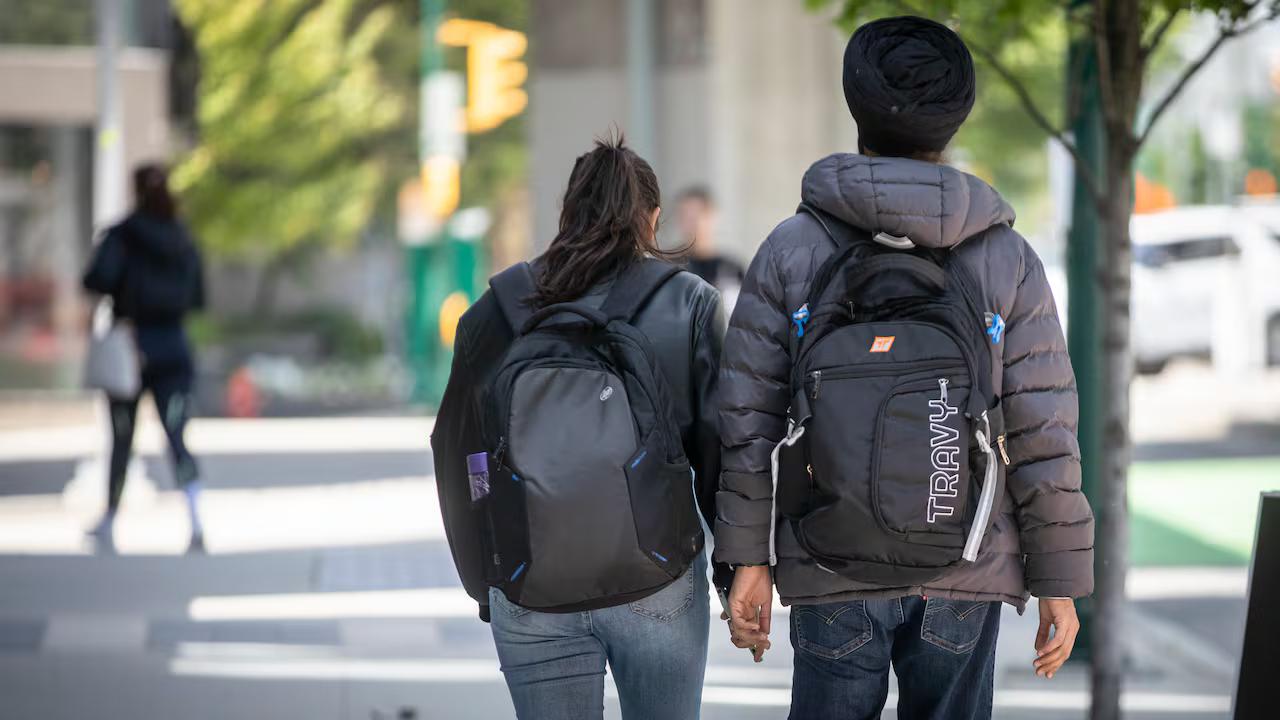
Students on campus, after Ben Nelms / CBC.
Our research shifted the focus to how Indian students in colleges experience international student life in Canada. Indian students who attend colleges are visible on Toronto’s streets (riding Uber bicycles) and on public transport as they commute two to three hours between their homes in the suburbs and their jobs in the city. Indian college students—many of whom come from farming communities and smaller towns in India—often mortgage or sell their property and take large loans to pay for their way into Canada. These students are positioned as the first to be exploited by employers and landlords. Many visit food banks or community kitchens and work multiple jobs and long shifts. Some expressed how they were treated as an exploitable resource. As one college student said:
Sometimes people call us modern slaves. It is slavery. Because you come to study, but you have to work because you are in a lot of debt. Everyone who comes here has a loan to pay back so they will work and stick to the same job, they will work extra hours and the companies they will utilize you… Your expenses are so high that even to get groceries has been hard. I have to go to food banks, stand in line to get food. We work so much that we are exhausted… I know people who have their Masters but who are line chefs… they are stuck and I feel this is the new slavery I was talking about.
As we learned from our interviewees, international college students from India have their wages stolen by employers, are threatened with deportation if they complain, are accused by the government of working illegally, and by colleges of “cheating” in their exams. And this experience of feeling “stuck” (Hage 2009) in an educational and labour regime that is compared to “slavery,” allowed us to compare the experience of college students to other forms of labour exploitation and plantation logics (McKittrick 2013). Yet, we also learned that, in response to adversity and adversarial policies, college students work to build community through migrant labour activism.
Student-Migrant Waiting as Political Awakening
During our research, we learned of instances when Indian students participated in collective actions and protests, against wage theft, against unfair government policies and bureaucratic delays, when employers withhold wages, and when colleges deny students their grades or accuse them of cheating. By actively navigating the specific predicaments of their own “waiting,” migrant-student activists engage with “new political orientations” and “potentialities for a different future” (Khosravi 2021: 17). One event, during the COVID-19 pandemic, stands out as important for Indian international students in Ontario, when an Indian student was deported for working over the 20-hour limit. In December 2017, Jobandeep Singh Sandhu, 22, was pulled over while driving a long-haul truck driving from Montreal back to Toronto. A college student studying mechanical engineering at Canadore College, Singh was ten days away from receiving his diploma when he was stopped by Ontario Provincial Police. Looking through his records, the police determined that he had been working more than the allowable 20 hours off-campus and arrested him. Singh was quickly scheduled to be deported for this. One interviewee recollects what this moment meant for him and how it inspired him to become an activist:
Most of the students, Indian students, I knew, they were working more than 20 hours. But none of us were really scared about it until that point, when the news story came out about Jobandeep Singh. And then I saw this organization, Migrant Workers Alliance, it was close to my home, it's fighting for international student rights, one of the demands is to end the 20-hour work restrictions, and so I visited them.
Through protest and activism, migrant student activists express a desire to participate in Canada’s labour economy and to help correct the inequalities caused by state and non-state institutions. Rather than feeling separated and in a growing sense of disconnectedness from other migrant workers in Canada, organizations like Migrant Workers Alliance provide Indian international students with a sense of purpose and collective community. Together with other migrant activist groups that defend the rights of Indian students, like the Naujawan Support Network, demands for social justice and equitable labour rights became firmly grounded in community and build actions that criss-cross different labour and migrant worker associations. Migrant-student waiting, once collectivized, provided a new orientation to labour and belonging in Canada.
Conclusion: The Unmasking Higher Education Podcast
In October 2024, we organized a full-day workshop called “Learning from and with Indian International Students.” The podcast “Unmasking Higher Education: Indian International Students in Canada” emerged from this workshop. It is an assemblage of different talks—by academics, journalists, students, and activists—that look at the multiple ways that Indian students experience, and are made to experience, international student life in the Greater Toronto Area. The seven episodes of this podcast provide a lens into Canada’s higher education and allow us to better understand what is happening today. Our first episode has now been released—subsequent episodes will be released every other Tuesday into March. Our podcast is hosted on Spreaker and is distributed and accessible on most of the major podcast streaming platforms.
On November 17, 2025, a group of about 150 Indian workers gathered outside a provincial government office in Toronto. They were protesting the suspension of the skilled trades stream, a provincial referral program that allowed international students trained in Ontario to work in Canada and eventually apply for permanent residency. “Fraudulent applications” was one reason the government gave for their sudden decision. Not long after, on December 11, 2025, Canada’s House of Commons passed through a third reading of Bill C-12, which included changes around border security along with new ineligibility rules for refugee claimants. One suggested change was that asylum claims made more than one year after arriving in Canada would not be referred to the relevant immigration and refugee boards. The Bill would also give the Immigration Minister authority to cancel permits for entire groups without due process—including revoking permanent residency applications already submitted—and make it harder for migrants crossing from the US to apply for refugee status.
There is an urgent need for us to have these conversations—around changing migration and refugee policies, settler-colonial and capitalist violence, and their impact on the lives of all of us who share this country. How can Canada do things differently, do better? This podcast is one small attempt to start that conversation. We hope you enjoy the episodes that follow and share them more widely.